

git closes the ISO 23894 treatment loop
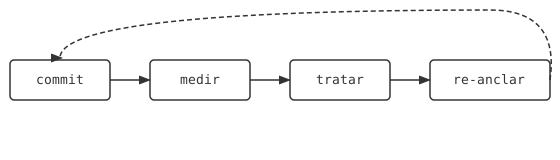
The diagram shows the full cycle: each treatment ends in a commit that updates the bundle anchor, and the cycle measures again on that basis.
The core thesis
Section titled “The core thesis”The risk treatment (ISO 23894 §6.5) is a change: to code, to a parameter, to a dataset. That change, when committed to git, becomes:
- versioned — identifiable by hash and attributable to an author with a date
- anchored — the engine signs the evidence bundle with ECDSA-P256+DSSE+in-toto against the triple (code digest, model digest, dataset digest)
- traceable by clause —
froga conformanceprojects the bundle onto the ISO 23894 and prEN 18228 catalogues
This was the limitation of the previous product: treatments were code changes that had to be collected by hand into the risk register. Making git close the loop — making the git log of the bundle be the treatment register — is what Venturalítica is.
froga reconstruct: replay of the cycle per risk
Section titled “froga reconstruct: replay of the cycle per risk”froga reconstruct reconstructs the treatment cycle per risk by replaying the git history of the evidence bundle (.froga/bundle.json). The process is deterministic and requires no language model.
For each identified risk, the report traverses five phases:
| Phase | What froga reconstruct does |
|---|---|
| ① Identification | Locates the commit that introduced the risk in the AssuranceProgram (git log -S <risk_id>) |
| ② Analysis | Retrieves the likelihood × impact → inherent level from the historical bundle |
| ③ Evaluation | Checks the inherent level against the appetite declared in froga.yaml |
| ④ Treatment | Reconstructs the empirical arc FAIL → PASS by commit (the applied treatment) |
| ⑤ Residual | Classifies the cycle: CLOSED / OPEN / DISCREPANCY / ACCEPTED (ISO 23894 §6.5) |
The output can be written as a signed artifact with --out (.froga/reconstruct.json + .sig).
See the froga CLI reference for flag and artifact details.
git blame = the audit log
Section titled “git blame = the audit log”In Venturalítica, git blame over the AssuranceProgram — the risk: section of froga.yaml — is the identification audit log: each risk has an author (who identified it), a date (when), and a commit message (why it was added). git log -S "<risk_id>" froga.yaml locates the commit that introduced each risk.
This satisfies the traceability requirement of ISO 23894 §6.4.2 (risk identification) without any additional infrastructure: the git history already contains all the information.
The Annex IV comes out by construction
Section titled “The Annex IV comes out by construction”Because each treatment is a versioned change and the evidence bundle is signed against the triple, the cloud (control plane) can assemble the Annex IV (EU AI Act Art. 11) directly from the signed bundle.json. The engine does not emit the Annex IV: it only leaves the signed evidence.
- Field provenance is declared/derived-bundle/derived-git
- There is no manual Annex IV drafting step
- The Annex IV reflects the real state of the system at the time of the last
froga run
The mechanism is built and demonstrated in the loan scenario. Completeness is partial: Annex IV §7 and §8 are never pending; §2/§3/§4/§9 can be pending if their input is missing. In loan, with data, controls and measures present, only §3 and §9 would appear pending (see Status & gaps).
Normative relevance
Section titled “Normative relevance”| Clause | How Venturalítica covers it |
|---|---|
| ISO 23894 §6.4.2 — identification | git blame + human declaration in froga.yaml (the KAG will assist in the future) |
| ISO 23894 §6.4.3 — analysis | Likelihood × impact 5×5, inherent level in the bundle |
| ISO 23894 §6.4.4 — evaluation | Inherent level vs appetite; per-criterion blocking in froga conformance |
| ISO 23894 §6.5 — treatment and residual | Empirical arc FAIL→PASS by commit; cycle classification in froga reconstruct |
| EU AI Act Art. 9 — risk management system | froga run gate (blocking controls); continuous monitoring via froga status in CI/CD |
| EU AI Act Art. 11 — technical documentation | The cloud assembles the Annex IV from the signed bundle (partial) |